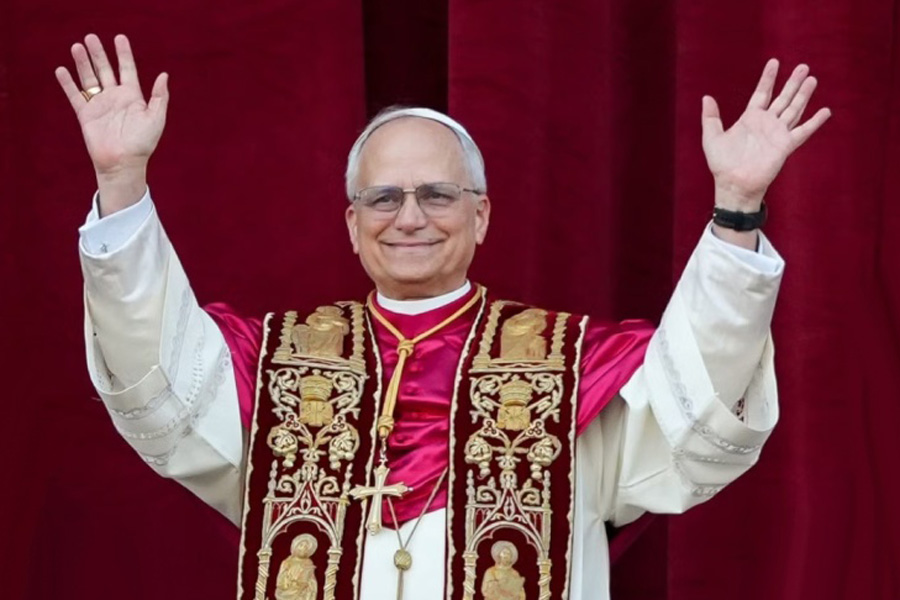
Pope Leo’s Trip to Africa
by Fr. Tony Okolo C.S.Sp., V.F. | 05/10/2026 | Weekly ReflectionBeloved Parishioners,
I share with you a reflection on Pope Leo XIV's visit to Africa. On his third ever international journey since his election as the supreme Pontiff, from 13 April to 23 April 2026, His Holiness Pope Leo XIV, completed a historic 11-day apostolic journey to Africa across four nations: Algeria, Cameroon, Angola, and Equatorial Guinea.
Angola and Equatorial Guinea are strongly Catholic-majority nations; Cameroon holds a substantial Catholic minority within a plural Christian environment, while Algeria represents a tiny Catholic presence within a predominantly Muslim society. Obviously, it is notable that far beyond diplomatic symbolism or state protocol, the Pope's visit to Africa functions as a pastoral and prophetic engagement with a continent that is increasingly central to the life and future of global Catholicism.
From 13-15 April, Pope Leo made a spiritual homage to the Land that holds spiritual legacies of the founder of the Augustinian Order, St. Augustine — Algeria. This was the first-ever time Algeria received a pope. In Algiers and Annaba, the Pope, himself an Augustinian, visited the ruins of Hippo, the defunct Episcopal See of Saint Augustine, to honor this prolific Doctor of grace. During his stay in Algeria, the Pope visited the Great Mosque of Algiers to promote Interreligious dialogue and peaceful coexistence between Christians and Muslims. Here, the Pope's emphasis was on peaceful coexistence, mutual respect, and shared human dignity, in continuity with the vision of Vatican II.
While in Cameroon from 15-18 April, the Pope made a clarion call for unity. In Yaoundé and Bamenda, he addressed the "Anglophone crisis" and urged for an end to the "chains of corruption". Additionally, he visited the Ngul Zamba Orphanage, meeting with children and students to promote youth apostolate.
Further, in Angola from 18-21 April, Pope Leo XIV, a pilgrimage of Hope, he prayed the Rosary at the Mama Muxima Marian Shrine, a site historically linked to the Atlantic slave trade. In meetings with President João Lourenço, he moved the cause of social justice and challenged leaders to break the cycle of resource exploitation and corruption. By so doing, manifesting the Catholic social teaching.
In the last leg of his stay in Africa, Pope Leo visited Equatorial Guinea from 21-23 April. In a highlight of the trip and an extension of love and mercy, the Pope visited the Bata Prison during a heavy rainstorm, praying the "Our Father" with inmates and declaring that "no one is excluded from God's love." He further visited the Jean-Pierre Olié Psychiatric Hospital in Malabo to support mental health advocacy, expressing strongly and concretely all the teachings of the Church about corporal works of mercy and preferential option for the poor and marginalized. The vivacity and refreshment that followed Pope Leo XIV's apostolic journey to Africa reveal a major ecclesial shift in which Africa is no longer viewed merely as a mission territory but as a vital center of Catholic vitality, vocations, and missionary dynamism. Africa is, without doubt, increasingly central to the future of global Catholicism, both demographically and spiritually.
At the same time, the Pope's visit took place in countries like Cameroon and Angola with complex political and social realities marked by challenges of governance, corruption concerns, economic inequality, and ethnic or social tensions. Due to this, the Pope's presence inevitably carries interpretive tension. Some critics question whether such visits risk being appropriated for political legitimacy by ruling elites. However, within Catholic understanding, the Pope's mission is directed primarily toward the people of God rather than political regimes. His presence ought to be therefore understood as pastoral solidarity which allows the Church to accompany suffering communities without abandoning them to isolation, rather than political endorsement of any kind.
In conclusion, Pope Leo XIV's visit to Africa can be understood as a living expression of the Church's self-understanding as missionary, pastoral, and prophetic. It is a Church that walks with its people, shares in their struggles, proclaims hope in Christ, and remains committed in the conviction that the Gospel is not merely an idea to be believed but a life to be lived within history.
BACK TO LIST